Due to local elections, some council services may be temporarily affected, which could lead to short delays in search turnaround times. We’re monitoring the situation closely and thank you for your patience while councils manage this period.
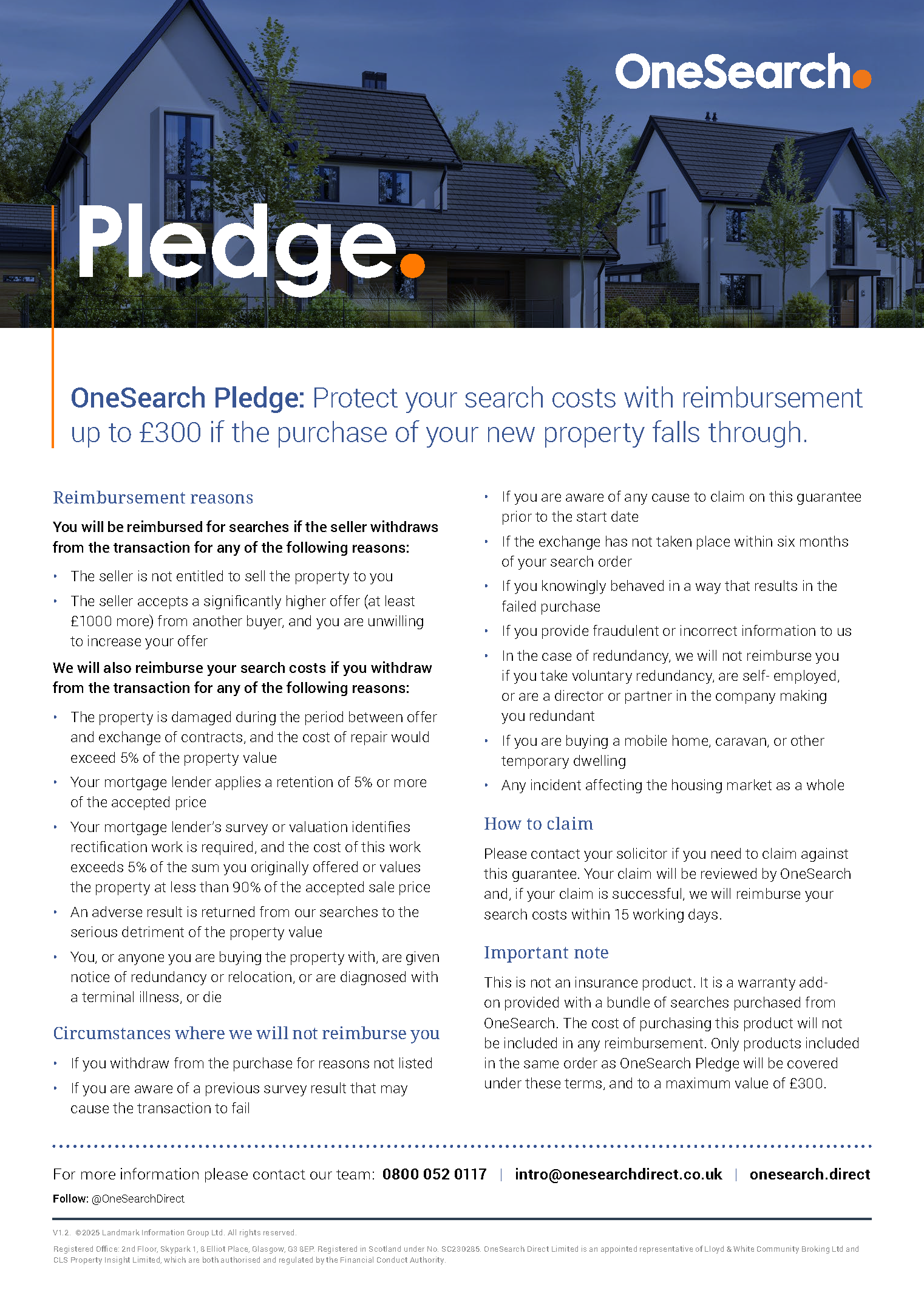
OneSearch Pledge is a low-fee seller search warranty that will reimburse your client’s search costs up to £300 if the purchase of their residential property falls through. Many home buyers are simply unaware that the chance of their purchase falling through is high, and correspondingly, so is the risk of losing their search fees.
In this blog, we will look at how providing OneSearch Pledge can enhance your reputation as a conveyancer and provide considerable peace of mind to your clients that their search costs will not be lost if their transaction does not proceed.
What is the true cost of residential property fall-throughs to the property sector?
Nearly one in three residential property transactions fell through in 2024 (an estimated 296,204 transactions), with each one estimated to cost the home buyer an average of £3,456; that equates to losses of over £1bn. The wider economic losses due to fall through are estimated at £8.6 billion. The UK’s high property fall-through rate is not just a statistic; it represents a significant risk to your clients’ finances and your firm’s reputation and efficiency.
Consider that for each residential property fall-through:
Estate Agents lose an average of £4,123 in costs
Home buyers lose, on average, around £3,500 in lost fees and charges for conveyancing, surveys, and searches.
While the estimates of costs vary, it is clear that the hundreds of thousands of property fall-throughs have an enormous impact on the wider economy, property transaction stakeholders, and potential buyers.
Why should home buyers choose OneSearch Pledge?
1. Small fee, big benefits
For a fee of approximately £15 per transaction, your clients can be reassured that should their matter fall through, they will receive up to £300 to cover their search costs. Given that the average cost of searches is around £400, this will return most of their search-related costs.
2. Position for your firm as proactive and caring
Offering a solution like OneSearch Pledge can really create a point of difference for your conveyancing practice, i.e., that you care. Many purchasers want to know that if their matter falls through for reasons outside of their control, they will not be financially out of pocket as a result. Not only does providing the assurance of Pledge show that you are committed to client care, but there will be a corresponding reduction in complaints and disputes arising from aborted transaction costs. Depending on your business model, you may choose to pass on the fee for Pledge or absorb this within your own costs in the knowledge that it may encourage more clients to choose your lower-risk offering.
3. A refreshingly simple solution
As far as the client is concerned, they simply need to tick the option to be covered by Pledge. There is no application form, detailed paperwork, or investment of their time. In the event that they need to claim against their Pledge warranty, all they need to do is inform their conveyancer, who will advise Onesearch. If the claim is approved, the amount is paid to the client within 15 working days.
One small fee, no paperwork, and an easy claim process
The exceptionally high level of fall-throughs in 2024/25 means that the risk of losing search fees is significant. While some customers will feel that they can absorb the cost of lost search fees if their matter falls through, many will not because they cannot afford to lose hundreds of pounds due to factors outside their control. By providing the peace of mind that Pledge provides, your conveyancing firm can demonstrate its commitment to customer care and respect for the precious financial resources of clients. We have made Pledge as simple as possible for all stakeholders – one small fee, no paperwork, and an easy claim process.
Frequently asked questions
How can I help my client understand the value of Pledge?
Many home buyers may take the view that the risk of their purchase falling through is negligible. It is important to explain that the rate of aborted transactions is much higher than people think (i.e. nearly one-third in 2024). Furthermore, there is no guarantee that any subsequent purchase transactions will go through the first time. As a result, the fees for aborted transactions may start to add up. The fee is extremely small in the grand scheme of the purchase, but having a pledge means that they won’t waste money that can be put towards searching for a future purchase.
Will Pledge reimburse the seller if the seller pulls out?
Any OneSearch fees will be reimbursed to the buyer if the seller pulls out of the transaction. Specifically, we will cover the search fees if the seller is not in a legal position to sell the property or they accept a higher offer from another buyer and the home buyer is not willing to increase their offer in response.
Will Pledge reimburse the buyer if the buyer pulls out?
Any OneSearch fees will be reimbursed to the buyer if they need to pull out of their purchase for a wide range of reasons, including:
If the searches reveal an issue that seriously affects the value of the property
Due to unforeseen circumstances such as serious illness or redundancy, and
The property being purchased is damaged and the cost of repairs is more than 5% of the value of the property.
For a full list of the criteria for reimbursement and situations not covered, please click here.
Is Pledge an insurance product?
No, Pledge is a warranty add-on offered when purchasing a bundle of searches OneSearch Direct only.
Covering Your Clients’ Search Costs With OneSearch Pledge
OneSearch Pledge
OneSearch is an expert partner to conveyancing professionals, offering innovative and practical solutions to navigate the complexities and risks of the UK property market. For more information on OneSearch Pledge and what it can do for your firm and clients, please complete the contact form at the bottom of the product page or contact our team directly by email: cs@onesearchdirect.co.uk or phone: 0800 052 0117
Are you looking to make your ordering process even smoother? We’ve just released two brand new how-to videos designed to help you navigate our order portal and mapping tool with ease.
Whether you’re a new customer or just need a refresher, these quick guides will help you get the most out of our services.
Watch Our Latest How-To Guides:
How to place an order via the OneSearch order platform: This video walks you step-by-step through our intuitive order portal. Learn how to easily place new orders, and track the progress of existing or previous ones, all in one convenient place. Say goodbye to confusion and hello to effortless ordering!
How to use our mapping tool when placing an order: Our mapping tool is a quick and easy replacement for when you are unable to source a pre-existing boundary plan, which is required as part of your order. This video will show you how to effectively use this tool to ensure accuracy and efficiency when placing your orders, saving you time and preventing potential issues.
We’re committed to providing you with the best possible experience, and these videos are just one more way we’re making it easier for you to do business with us.
Ready to Dive In?
You can find these new videos, along with our full library of helpful guides, on our official YouTube channel.
We hope these resources help streamline your ordering process and enhance your experience with us. Do you have any other video topics you’d like to see covered in the future?
This report, from our parent company Landmark, features the latest data on residential property transactions, including listings, SSTC/SSTM figures, search orders and completions.
Our data for Q1 ‘25 reveals signs of a resilient market and a stable transaction pipeline emerging following the spike in completions ahead of the Stamp Duty Land Tax (SDLT) reversal deadline in England and Wales.
Completions rose by 30% over the quarter, with a 71% year-on-year surge in March alone as buyers rushed to complete. Beyond this much-anticipated bubble of activity, underlying indicators point to a more resilient property market heading into Q2.
The Scottish property market continued to hold firm, avoiding any notable market distortion following changes to Land & Buildings Transaction Tax (LBTT – the Scottish equivalent of SDLT).
Other key findings from Q1 ‘25 include:
Listing volumes in England and Wales were comparable to Q1 ‘24, up by just 1%. In Scotland, listing volumes were up 11% for the quarter compared to Q1 ‘24.
In England and Wales, SSTC volumes were down 9% compared to Q1 ‘24. Conversely, SSTM volumes in Scotland were up 9% vs Q1 ‘24.
Completions were up 30% in England and Wales (+71% in March alone). In Scotland, completions were up 16% compared to Q1 ‘24.
Download your copy of the Cross Market Activity edition for England, Wales and Scotland, which includes the latest residential property market data and insights for Q1 2025.
Is your firm struggling with the requirements of Anti-Money Laundering compliance?
You’re not alone. The latest industry standards and guidelines are complex, and the cost of non-compliance can be substantial.
Our infographic highlights the hidden expenses associated with manual KYC checks, missed deadlines, and non-compliance penalties in 2025. It also shows how OneSearch can help you significantly lessen these costs and improve your bottom line.
The conveyancing sector is undergoing significant transformation, driven by technological advancements and the need for greater efficiency.
Artificial Intelligence (AI) has the potential to support various aspects of conveyancing, helping to mitigate persistent challenges and enhancing the overall process.
We’ve taken the industry view from our recent Residential Market Research Report, which surveyed residential property solicitors and conveyancers from across England, Scotland and Wales, and our own experts to collate the following list of benefits that conveyancers can derive from using AI.
1. Automation of labour-intensive tasks
As part of our market research, we asked conveyancers to select the top three options for the question, ‘where do you see AI being the most useful in real estate?’, the top response was the streamlining of general administrative tasks (28%).
AI could help to reduce the burden of repetitive and mundane chores, allowing conveyancers to focus on higher-value activities. For instance, it can automate the process of document reviewing and data extraction, both of which are typically time-consuming and prone to human error. By leveraging AI, conveyancers can streamline these tasks, improving accuracy and efficiency.
“AI can take away those labour intensive or laborious tasks, so that you’re allowing conveyancers to focus on the task where they add the most value, and they probably get more satisfaction in their own role day to day,” says Rob Steadman, Sales Director within Landmark Information Group.
2. Risk assessment and management
Digitisation and automation can also play a supporting role in risk assessment and management. When asked the question “To what extent has digitising and automating certain conveyancing tasks delivered the following benefits in your business?”, nearly three-quarters (74%) of survey respondents said that automating certain tasks had improved risk management for lawyers and conveyancers to a ‘great’ or ‘some’ extent.
“Understanding risk in a transaction earlier will help to support the process and the workflow management,” says Rob. “AI helps with automation, managing risk, and with the ability to price immediately.”
AI can also analyse vast amounts of data to identify potential risks, such as property disputes, environmental hazards, and compliance issues. This early identification allows conveyancers to address these risks proactively, reducing delays and ensuring smoother transactions.
3. Enhancing due diligence
Due diligence is a critical component of the conveyancing process, involving thorough checks on the property’s legal status, ownership, and any potential encumbrances. When asked, “what do you see as benefits of receiving data insights on the property and location,” just under two-thirds (65%) of respondents in our survey said that upfront data insights for transactions would remove delays earlier in the process.
“AI can enhance due diligence by providing comprehensive information, and ensure no critical information is overlooked,” says Allie Parsons, Customer Success Consultant at Landmark Information Group.
AI-powered tools also have the potential to quickly analyse property records, historical data, and other relevant documents to identify any red flags. This can not only speed up the due diligence process but also ensures that no critical information is overlooked.
4. Improving communication and transparency
According to our research, when answering the question “Thinking about the transactional process, what is your biggest frustration in your role as a residential conveyancer?”, 31% of conveyancers placed “Poor communication among all the transaction stakeholders”, within their top three concerns, the same level as being chased by or having to chase other stakeholders.
“Effective communication and transparency are essential for successful conveyancing transactions,” says Liz Jarvis, Divisional Director of Legal and Search at Landmark Information Group.
AI could facilitate this better communication, for example, by providing a centralised platform where all stakeholders can access real-time updates and information. Rob adds: “A central hub that provides real-time updates on the status of various tasks could significantly reduce the time spent chasing information.”
AI-powered chatbots could handle routine enquiries from clients, providing instant responses and reducing the need for manual follow-ups. This improves transparency and keeps all parties informed throughout the transaction.
5. Document management and verification
The conveyancing process involves handling numerous documents, from contracts and title deeds to mortgage agreements and compliance certificates. AI has the potential to streamline document management and verification processes.
AI can automate the process of verifying the authenticity and completeness of documents, ensuring that all the necessary paperwork is in order. This can help to reduce the risk of errors and omissions, which can lead to downstream delays and complications in the transaction.
6. Predictive analytics for market trends
AI could provide valuable insights into market trends and property values through predictive analytics. By analysing historical data and current market conditions, AI could forecast future trends, helping conveyancers and their clients to make more informed decisions.
For instance, AI could predict property price fluctuations, identify emerging market hotspots, and assess the impact of economic factors on property transactions. This information can be invaluable for conveyancers when advising their clients and planning their strategies.
7. Enhancing client experience
Improving the client experience is a key goal for conveyancers. Digitisation, automation, and AI can play a significant role in achieving this. When asked about the extent digitising and automating certain conveyancing tasks delivered benefits to their business, nearly three quarters of our survey respondents (73%) replied that it had improved the overall customer service and customer experience for buyers and sellers by providing a more transparent process.
“Improving the client experience is key, and AI can personalise updates, reminders, and recommendations based on individual client needs,” says Allie.
For example, AI could send automated notifications about the status of the transaction, upcoming deadlines, and any required actions. This keeps clients engaged and reassured, enhancing their overall experience.
8. Training and skill development
When prompted to choose three possible answers to the question: “thinking about your role, what do you think needs to be improved in order to attract and retain more talent in the sector?” The second and third highest selected replies were ‘enhanced training / development support’ (37%) and ‘better technology to reduce workloads’ (36%).
This opens up the discussion around how AI could support the training and skill development of conveyancers. For instance, AI-powered tools could be used to train new entrants into the profession, providing them with interactive learning experiences and real-time feedback.
“Addressing skill shortages requires a careful balance to ensure that technology enhances rather than suggest it could replace the role of conveyancers” says Rob. AI can simulate various scenarios and challenges that conveyancers may face, helping them develop the necessary skills and knowledge.
This can help to address the skill shortages in the sector and ensure that conveyancers are well-equipped to handle more complex transactions. Allie adds, “AI could support the training and skill development of conveyancers, providing interactive learning experiences and real-time feedback.”
Conclusion
The integration of AI, as well as digitisation and automation, into conveyancing offers numerous benefits, from automating labour-intensive tasks and enhancing due diligence to improving communication and client experience.
AI offers conveyancers the potential prospect of optimising workflows, minimising potential errors, and reallocating their time to more focus on high-value activities. As the property market continues to evolve and the possibilities of AI expand, choosing the right path may appear daunting. However, seeking guidance, connecting with colleagues to share experiences, and taking a phased approach by improving one key process and building from there can provide a more manageable and ultimately successful implementation strategy.
We are delighted with the response to OneSearch AML since we unveiled the product last summer; we hope you’ve had the opportunity to explore yourselves into the solutions it can provide your firm when it comes to managing risk and protecting your firm.
We understand the world of Anti Money Laundering can seem overwhelming at times: new regulations, confusing jargon and acronyms… and that’s not forgetting keeping on top of ever-evolving fraud strategies. On top of all that, you may often find yourself explaining this to your clients as well.
To help you conquer compliance, and master your firms AML checks in 2025, we’re offering a downloadable guide packed with practical advice and best practices for conveyancers.
In our guide, you’ll learn about:
Understanding your KYC/AML Obligations in 2025
A comparison of Manual vs Digital AML Checks
A detailed explanation about the Safe Harbour Standard
A guide to the most common AML phrases and what they actually mean
And also:
A full breakdown on the features and benefits of OneSearch AML, the most comprehensive anti-money laundering solution on the market.
Fill in the form below to download your complimentary 2025 AML guide: