Climate change is no longer a ‘next generation’ threat; it’s on our doorstep impacting many different aspects of our lives, not least within the property sector.
Buildings are a major contributor to greenhouse gas emissions, and the effects of climate change are posing considerable risks to property values and future habitability. It is now undeniable that our sector needs to adapt.
“The property sector is a big part of the problem, as today, 40% of greenhouse gas emissions come from our buildings. If left unchecked, this is set to double by 2050.”
– Chris Loaring, Group Sustainability Director, Landmark Information Group
To understand how the property industry is starting to adapt, Landmark conducted comprehensive market research of 150 senior level employees working in estate agency, residential conveyancing, and mortgage lending across England, Scotland and Wales. Our findings have helped us gauge the growing commitment towards sustainability, and how we can help support and nurture this further.
The consensus from the industry
Our report, “Climate change in the property sector: a cross-market perspective,” takes a thorough dive into the findings:
Growing concern
Climate change is no longer a distant threat. A significant majority of property professionals (72%) recognise the urgent need to address its impacts. This growing awareness is driving a shift towards sustainable practices within the industry.
Client awareness
Property professionals said that clients are increasingly concerned about the potential effects of climate change on their property purchases. Flooding (60%), energy efficiency (58%), and local planning (56%) are among the top priorities for homebuyers. As climate risks become more apparent, these concerns are influencing decision-making processes.
Shifting practices
The property industry is adapting to the changing climate, and more professionals are actively advising clients. For example, mortgage lenders are, on average, advising 48% of their clients on potential climate change risks to their property, a similar number can also be seen from estate agents (49%).
Room for improvement
While the industry is making progress, there is still room for improvement. Less than 60% of conveyancing firms are currently on track to meet carbon emission targets. This highlights the need for continued efforts to reduce the industry’s environmental impact.
Encouragingly, more businesses have created net zero strategies (76%, up from 52% in 2023). Conveyancers have made significant progress, with 48% having published their own strategies. This is a demonstrable sign at just how much positive momentum towards solutions the industry is taking when it comes to the fight against climate change.
Download our report
To gain a deeper understanding of the trends and insights from our research, download your copy of ‘Climate change in the property sector: a cross-market perspective‘ here:

*World Green Building Council report: Embodied Carbon – World Green Building Council (worldgbc.org)
The latest data from Landmark reveals that listing volumes are averaging 6% higher than in Q2 2019 which we use as the benchmark year, indicating that supply is the strongest it has been in years.
However, transactions are struggling to progress to completions, reflecting ongoing affordability issues driven by high interest rates and the uncertainty of a General Election. Sold Subject to Contract (SSTC) levels are down 32% compared to Q2 2019. Similarly, completion rates, despite showing moderate growth in May, remain around 40% below where we’d expect in normal market conditions.
Despite these challenges, the data suggests that the market is poised for a potential upturn in the latter half of 2024, provided economic stability improves and systemic inefficiencies are addressed by the new Government, alongside the wider industry.
Notable headlines in England, Wales and Scotland from Q2 2024 include:
- In England and Wales, listing volumes were up 6% in Q2 ‘24 vs Q2 ‘19. In Scotland, there was a slight decline in listing levels versus Q2 ‘19 with volumes down 4%.
- In England and Wales, SSTC volumes in Q2 ‘24 continued at Q1 levels – 32% lower when compared to Q2 ‘19 volumes. In Scotland, SSTM continued to slow, down 16% in Q2 ‘24 vs Q2 ‘19.
- In England and Wales, completion levels in Q2 ‘24 remained the same as Q1 ‘24 – 41% down vs Q2 ‘19 volumes. In Scotland, completion volumes were down 5% in Q2 ‘24 vs Q2 ‘19.
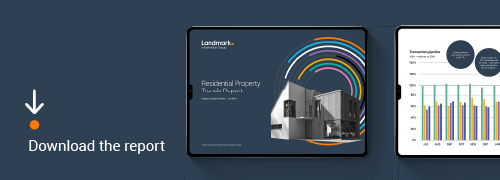
Download the report to discover the latest trends impacting the residential sector in Q2 2024.
Tired of spending hours on Anti-Money Laundering checks?
We’ve all been there. But what if you could streamline the process and get it done in minutes?
In the following video, we’re introducing you to OneSearch AML, your one-stop shop for fast and efficient Anti-Money Laundering checks. We’ll take you step-by-step through the process of adding OneSearch AML to your conveyancing order, and show you exactly what your client will experience during verification.
See how it works in the video below:

Get ready to say goodbye to lengthy AML processes and hello to a smoother conveyancing experience!

The Q1 2024 release of Landmark’s Residential Property Trends Report is now available. This report contains the most recent data from the residential property transaction pipeline, covering listings, SSTC/SSTM, searches ordered and completions.
Our latest data gives reason for cautious optimism: listing volumes remain strong, building steadily through Q1 ‘24 in England and Wales. Listing numbers in Scotland also began on a positive footing.
Key findings from Q1 ‘24 include:
- In England and Wales, listing volumes in Q1 ‘24 were up 5% vs Q1 ’19. Listings in Scotland were down just 2% in Q1 ‘21 vs Q1 ‘19.
- SSTC volumes in England and Wales for Q1 ’24 tracked 32% below Q1 ‘19, with SSTM levels in Scotland 22% down vs Q1 ‘19.
- Completion volumes in England and Wales for Q1 ‘24 were down 41% compared to Q1 ‘19 levels. In Scotland, completions were down 2% in Q1 ‘24 vs Q1 ‘19.
Download the Cross Market Activity edition covering England, Wales and Scotland, unveiling the latest residential property market data and insight for Q1 ‘24.
We trust you’ll find this report to be a valuable guide as we move into the second quarter of 2024.

Remote ID Verification is a method of confirming the identities of individuals such as clients or customers who are not physically present. Whereas antiquated methods of confirming identity required persons to be in the room as well as providing documents, the advancements of technology have meant authentication processes can now be carried out anywhere in the world.
In this blog, we’ll take a closer look at a faster, more accurate and more secure form of identity verification, and break down what each component is, and how they all add up to make the AML biometric verification process so much easier.
It starts with liveness detection…
What is liveness detection?
In remote identity verification the use of liveness detection is critical in preventing presentation attacks or “spoofs”. Essentially, it is to make sure the individual carrying out the test is a) real, and b) who they say they are.
Common spoofs include:
- Masks
- Photographs or digital prints
- Digital screens
- Video playbacks
There are two forms of liveness detection; Active and Passive.
- Active Liveness, where a user is instructed to perform an action, such as blink, move your head from side to side, or smile.
- Passive liveness works unnoticed in the background without requiring any additional steps from the user. It includes use of AI technology and deep neural networks to detect spoofs.
As passive liveness requires no response from the user, it is often the case that they occur without the user being aware a liveness check is taking place, let alone what security mechanism is being used. This reduces the risk of fraudulent access and identity theft.
What other examples are there in life of passive lifeless tests?
You may start noticing passive liveness tests in more and more in everyday activities, from airport security to mortgage applications.
- Facial recognition systems: Banks, airports, border control, and other security-sensitive applications
- Remote document verification: Online onboarding for financial services, healthcare, and other sectors
- Mobile authentication: Secure access to mobile apps and accounts
Passive liveness is a rapidly evolving technology with the potential to significantly enhance security and convenience in various applications.
Methods:
- Document verification: Uploading scans or photos of government-issued IDs and comparing them to official databases
- Facial recognition: Using a webcam or smartphone camera to capture a live image of the person and comparing it to the photo on their ID
- Knowledge-based authentication: Asking the person security questions based on information they are likely to know
- Third-party data verification: Checking the person’s information against public or private databases, with their consent
It is that time of year again when conveyancers from across the UK come together to discuss important matters within the industry and trends for the future – National Conveyancing Week 2024.
The theme for the second day was mental health and well-being in the property sector, a topic that is often overlooked. In 2024, what are the residual impacts of COVID-19 on our sector’s mental health, what are the pressures faced by conveyancers, and what does working from home mean for our mental well-being?
Four years on from the COVID pandemic
While it may seem a long-distant memory for some, some within the industry believe that conveyancers are still reeling from the impacts of COVID-19 on UK property transactions. Robin Wells, Head of Sales Operations:
“I still firmly believe, as much as people will deny it, we’re still in a post-COVID slump in terms of struggling to cope with what happened and struggling to cope with what is normal.“
The loss of human contact felt during the pandemic and since the shift to working from home has undoubtedly left many feeling isolated and lonely and grappling with the question of what normal now means. Robin goes on to say:
“What is normal now? What’s a normal working environment? What’s work-life balance? What should that be? These are all buzzwords and things that are being said, but actually, what is it? What’s healthy? What’s not healthy? I think people trying to come to terms with that and find out what it is and how they get the best out of themselves and the best quality of life while working in this environment is tough”.
It may be that, in many ways, we are all still somewhat shocked by what happened in 2019 and 2020. Not everyone has had the chance to go back, debrief, and have a collective conversation about what happened, how we felt, how we now feel, and what it now means for our livelihoods. National Conveyancing Week provides an excellent forum for this to happen.
The relentlessness of the industry on mental health and well-being
For conveyancers in the UK, the relentlessness and demands placed on them can have a negative bearing on their mental health and well-being. The seemingly endless cycle of meetings on Teams and Zoom can also make us feel disconnected. This is a sentiment that Robin Wells, Head of Sales Operations at OneSearch, resonates with:
“It is nice to go out with a customer out of the office and just say, how are you? It’s as simple as that. How are you? You’re not selling anything. That comes later. But you’ll just say, how are you? How have you been? How are you feeling? I mean, because of COVID, people don’t talk like that anymore. It’s straight onto teams, straight onto an agenda”.
So what is the solution? For Elizabeth Jarvis, Managing Director, the key is setting boundaries and being present with loved ones:
“It is easier said than done and as somebody who used to be the world’s worst for being on email late at night, it is putting firm boundaries in place for yourself. Not just for you but for being present for your loved ones, for people around you and your family. Because I think we all recognise that when your home life is going well then that has a really good positive impact on your professional and your working life too. So you don’t just owe it to us, we owe it to the people who are closest to us as well”.
Emotional rollercoaster
Conveyancers often find themselves responding to the demands of a market that is either overheated or in a lull. The impact of this on mental health is overlooked, but the reality is we are sometimes swinging from too busy to not busy enough, resulting in concerns over job security, a genuine ‘emotional rollercoaster’. As Elizabeth Jarvis explains:
“You see, when you look at it, you think when it’s boom, it’s stressful because we’re running about like mad trying to get all these transactions through when we think about 2022, everybody was just running to stand still. People were working huge hours, you know, just trying to get all these transactions through and make the most of a really buoyant market…And then the market flattens and goes towards a natural connection again and it takes time for it to come back. And then that’s when everybody realises that they need to be really competitive. And how do they do that? And, you know, how do they retain the talent through the difficult periods?”.
Final words
We should make the most of any opportunity to discuss the mental health of conveyancers. We have all been through such an immense period of turmoil in the form of COVID-19, and market conditions remain uncertain with the background of war in Ukraine and stubbornly high mortgage interest rates. The more that we can all get together, laugh, reflect, and be optimistic about the future, the better for our collective mental health. For Elizabeth Jarvis, “It is about getting in to see a customer, getting to see your colleagues again, having that laughter brought back in again into daily life”. After all, the British are experts at this; a packet of your favourite biscuits, a cup of tea, and a chat, is sometimes all it takes to feel ‘normal’ again.