Landmark’s latest market research suggests the industry’s biggest challenge is no longer access to climate risk data, but interpreting it.
With 90% of conveyancers saying they would act sooner if climate information was easier to access and interpret, the opportunity is not more data, but helping professionals understand what matters, what it means and what happens next.
Key research takeaways
- Climate risk is now considered as important as other mainstream due diligence checks by 82% of conveyancers.
- 90% of conveyancers would act sooner if information was easier to access and interpret.
- Research suggests the next challenge is helping conveyancers interpret which risks matter, what they mean and what action they should advise.
Why more climate data doesn’t automatically create better decisions
As climate risk gains prominence, conveyancers often find themselves navigating an expanding range of datasets, reports and risk indicators. Yet, more information is not always synonymous with greater confidence.
Eighty per cent of conveyancers said that their organisation feels confident explaining what climate risk information does and doesn’t mean for a property. However, significant challenges remain around regulation, responsibility and consistent interpretation across the sector.
This suggests the conveyancing industry’s next challenge may not be information availability, but information relevance. “Conveyancers are busy people,” explains Elizabeth Jarvis, Managing Director at OneSearch. “They don’t necessarily need more data. They need confidence that they’re focusing on the information most relevant to the decision in front of them.”
Whether considering flood exposure, ground stability, heat stress or energy performance, understanding how different factors connect and which are most material can often be more valuable than simply receiving additional information.
Climate awareness is no longer the problem
Sixty per cent of conveyancers have seen increasing client concern around climate change over the past year, while more than four in five (82%) now view climate risk information as becoming as important as other mainstream due diligence checks.
For Elizabeth, this reflects a broader shift in market maturity. “Most conveyancers now recognise that climate considerations form part of the wider due diligence picture,” says Elizabeth. “The challenge is no longer building awareness. It’s helping people understand what information is relevant, what it means in context and how it should influence decision-making.”
Why interpretation is becoming as important as information
One of the most striking findings from the research is that 90% of conveyancers say they would act sooner if climate information was easier to access and interpret. At the same time, 80% believe climate risks are still being identified too late to prevent disruption in many transactions.
These results point to an important distinction. Access to data alone does not automatically lead to action. Identifying a potential climate-related risk is often only the beginning of a much wider process. Conveyancers still need to determine how relevant the finding is to a specific property, what level of concern it may warrant and whether any further investigation may be appropriate.
“A climate alert on its own rarely provides a complete picture,” says Elizabeth. “Conveyancers need help assessing the significance of that finding within the context of the property, the transaction and the decision they’re trying to make. That’s where interpretation becomes incredibly important.”
Download the report
Landmark’s latest market research report, Climate change in the property sector 2026, explores how conveyancers, estate agents and mortgage lenders are responding to climate risk, where the biggest challenges remain and why interpretation is becoming just as important as climate risk data itself.
The findings suggest the industry’s next phase of maturity will not be defined by access to more data, but by helping professionals focus on what matters, understand it in context and apply it with confidence.
Download the report to explore the full findings and discover why clearer, more interpretable climate insight could be one of the property sector’s biggest opportunities.
Climate considerations are becoming embedded in conveyancing but timing and consistency remain key challenges.
Our parent company Landmark’s latest climate change market research shows:
- 81% of property professionals now treat climate risk as core due diligence.
- 75% say risks are identified too late to prevent disruption in many transactions.
- Responsibility is still shared across stakeholders but is not yet clearly defined.
The next step is clear: ensuring climate insight is delivered early enough, and clearly enough, to support confident client decisions.
Download Climate change in the property sector 2026: turning insight into action to learn more.
Climate change is no longer a distant threat for the UK property sector, it’s a present-day reality, influencing everything from buyer behaviour to professional advice.
Landmark’s latest cross-market research draws on the perspectives of 150 senior property professionals, including 50 estate agents, 50 residential conveyancers, and 50 mortgage lenders, to reveal how the industry is adapting to this new landscape, where climate risk is now a central part of the conversation.
Climate risk moves to the forefront
Over the past year, concern about climate change has become nearly universal among property buyers and professionals. The sector is seeing this shift first-hand. The days when climate risk was a niche topic are over; it’s now a mainstream consideration that can make or break a transaction.
This heightened awareness is having tangible effects. Conveyancers report that buyers are increasingly willing to walk away from deals if climate risk reports raise red flags. The financial implications are significant, with concerns about mortgage approvals and insurance coverage now tied directly to climate-related findings.
What’s driving this change?
The research points to a shift from general uncertainty about climate change to more practical, property-specific concerns. Energy performance remains a top priority, but more regular heatwaves have pushed heat stress up the agenda. Buyers and professionals alike are asking tougher questions about how homes will cope with rising temperatures, and what features, such as, ventilation, insulation, and EV charging points will help future-proof their investments.
Flooding, once the dominant concern, has slipped down the list, replaced by worries about heat, subsidence, and even coastal erosion. This suggests a more nuanced understanding of climate risk, with buyers looking for homes that are resilient to a wider range of environmental challenges.
Professional advice is evolving
As climate events become more frequent and severe, property professionals are adapting their approach. The majority now recommend further due diligence, such as, climate risk reports earlier in the buying process. There’s also a growing trend towards upfront disclosure, with estate agents increasingly confident in discussing climate risks with clients from the outset.
However, the question of who should take responsibility for advising on climate risk remains open. While environmental specialists are still seen as key, more estate agents and conveyancers are stepping up, supported by new best practice guidelines and internal policies. The Law Society’s recent practice note has provided some clarity, but many professionals are still navigating how to put this guidance into practice.
Barriers and opportunities
Despite this progress, the sector faces real challenges. Uncertainty around regulation and a lack of clear client demand are slowing the pace of change. Data gaps, limited training, and the cost of new tools are also barriers that need to be addressed. Yet, there are signs of optimism: more firms are developing and publishing net zero strategies, and consumer demand for sustainable features is rising fast.
The road ahead
Landmark’s latest research makes it clear that the property sector is at a turning point. Climate risk is now a core part of property decisions, and the industry is responding with greater transparency, better advice, and a stronger focus on resilience. The journey isn’t over, there’s still work to do to embed best practice, clarify responsibilities, and support buyers in making informed, future-ready choices.
But as extreme weather becomes the new normal, one thing is certain: the property sector can’t afford to stand still. Those who adapt will be best placed to thrive in a climate-conscious market.
Download the full report to explore the data, insights, and recommendations shaping the future of UK property.
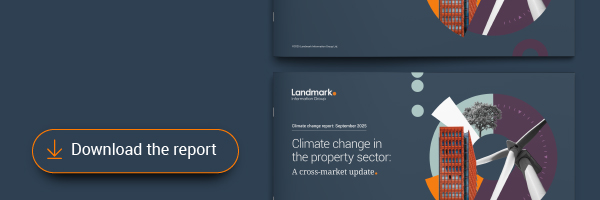
Climate change is now having a systemic effect on the property market. Landmark’s latest market research report – Climate change in the property sector: A cross-market update, seeks to understand what progress is being made on climate change related resilience and what notable barriers remain.
For this report, Landmark interviewed 150 senior property professionals: estate agents, residential conveyancers and mortgage lenders; all with decades’ worth of experience. In a muted market, beset by other pressures, conveyancers report buyers are increasingly walking away from risky transactions, suggesting a growing consumer sensitivity and more serious financial implications attached to climate data.
Some of the key findings of our 2025 research include:
- 99% of property professionals say their clients are concerned to some degree with the evolving / future potential threat of climate change when buying a property.
- 93% of property professionals say that recent climate events have impacted the way they advise clients to think about climate related risks and how they could affect their home.
- On average, property professionals are advising 52% of their clients on potential climate change risks to their property (up from 50% in 2024).
- Nearly three quarters (74%) of the conveyancers we spoke to now have a net zero strategy.
Download the report by clicking below.
On the latest episode of Landmark Talks Property, we sat down with Landmark’s Group Sustainability Director, Chris Loaring, and OneSearch Managing Director, Liz Jarvis, to discuss sustainability in conveyancing.
This conversation explores the critical role of sustainability in the real estate sector, highlighting the challenges and opportunities that arise from climate change reports and regulatory requirements. Chris Loaring discusses the importance of education, the need for support in navigating complex regulations, and the benefits for firms that adopt sustainable practices early. The dialogue emphasizes the evolving landscape of consumer expectations and the necessity for firms to engage with sustainability initiatives proactively.
To read the blog which accompanies this audio podcast, please click here.
To listen to more Landmark Talks Property episodes on Spotify, click here.
To find out more on Landmark’s sustainability offering, and for the opinions from experts across the property industry including Latham & Watkins, Taylor Wimpey, Savills, please visit sustainability.landmark.co.uk

Sustainability is not just a trend; it is a fundamental shift reshaping the property sector. As climate change concerns evolve and environmental regulations tighten, conveyancers, at the business end of property transactions, are pivotal in guiding clients through all the complexities.
But how, with increasing expectations from home buyers, can small law firms adopt sustainable practices to survive and thrive?
Following the release of Landmark’s reflections and predictions sustainability guide, OneSearch Managing Director, Liz Jarvis, sat down with Landmark’s Group Sustainability Director, Chris Loaring, to discuss sustainability in the property industry and how conveyancers can adapt practices to meet new challenges and expectations.
Sustainability is no longer optional
In 2024, Landmark research showed 93% of property professionals say their clients are concerned about the future threat of climate change. They are increasingly conscious of impacts, energy costs and future-proofing their investments and want to understand flood risks and energy efficiency and how environmental considerations directly affect their property’s value.
This will only increase as the new generation of first-time buyers – typically around 40% of the market – drive conversations, inspired by social media trends and environmentally conscious awareness, and ask for more education.
They will turn to their conveyancers to guide them through the environmental issues and complexities related to their home buying – “so conveyancers need to be ready to answer questions and address those concerns” explains Liz.
At OneSearch, we see businesses that support clients with confident sustainability advice “are creating a really great opportunity for themselves,” says Liz. By moving early, building a strong supply chain, network and partners, they “find mutual value very, very quickly,” agrees Chris.
Conveyancers’ key role
Conveyancers have a crucial role to play in helping clients navigate the environmental aspects of home buying. But it’s more than that for conveyancers, who, to meet new regulations and disclosure requirements, also need to understand how climate change might affect a property’s future value and usability, considering (and explaining to clients):
- its resilience to climate change, including flood risks and extreme weather events
- future costs of meeting energy efficiency standards
- sustainable features that might affect property value
- local planning policies, environmental protection, and development restrictions
Unfortunately, the complexities of climate change analysis and demands from clients make a hard job even harder for small conveyancing law firms. “It is understandable that fear and a lack of knowledge are holding back many conveyancing practices,” says Chris Loaring.
“We know conveyancers take on a risk when they accept the responsibility to advise clients on sustainability,” explains Liz. “So, as conveyancing partners, at OneSearch, we provide accurate, reliable information, minimising that risk. We endeavour to make it easy for people to interpret, digest, and understand the information we provide.”
Landmark: leading the way with practical tools and resources
Landmark, uniquely, is involved at all stages of a property transaction, so we use our knowledge to support conveyancers and help them succeed in this evolving landscape.
“We work with agents, upfront, before a property goes on the market,” explains Chris, “then with the lenders as they prepare a mortgage offer, and finally with the conveyancer as they work through the complexities of the property transaction. We see every link in that chain.”
And to support every link in that chain, Landmark has committed to supporting the property sector in its transition to a sustainable future, sharing valuable products and services to address the growing need for sustainability expertise.
“We made the call in 2020 to set sustainability and climate change reporting as a priority, making net zero important to us as a business and to take with us the industries we partner with on the journey,” explains Chris. “We were the first property-related data business to sign up to the pledge to net zero, for example.
“But we found none of our partners really knew where to start in our shared journey to net zero – and we wanted to help. So, we spent a lot of time and effort creating a really accessible, free-to-use starter guide: a six-page document with a tangible starting place.
“Other partners already had a commitment, a pathway, and maybe a progress plan, so we can review, advise, and show them where they can improve in their journey to net zero.”
Beyond face-to-face consultation and ongoing support, we have a suite of digital platforms and software solutions that help our partners track and manage environmental compliance, so they miss nothing during the transaction. These tools can automatically flag potential issues and suggest actions, keeping high-street firms ahead of the curve and thriving.
Building a sustainable firm
Embracing sustainability is more than just meeting legal obligations; you need to future-proof your conveyancing practice. The onus is on law firms to set and implement policy, establishing a process that works for your business.
Liz continued, “We find early adopters and forward-thinking firms that champion expertise in environmental aspects of property transactions can expand the type of work they do and increase their revenue.”
Taking advice from a trusted partner is a great first step; they can tailor an approach that fits your profile and process. This is so much more than box ticking with a single product – this is an opportunity to make business sustaining changes that will drive a prosperous future, financially as well as for the planet.
Incorporating sustainability considerations into your day-to-day business enhances firm reputation and client satisfaction. Younger buyers, in particular, appreciate conveyancers who can speak knowledgeably about sustainability issues and provide practical guidance on environmental considerations.
In 2025, there will be new guidance on how to manage climate change in conveyancing. The main part, part A, focuses on your firm’s own ESG and net zero promises, while a smaller part covers climate risks in property sales.
Nonetheless, it is the smaller part B that conveyancers are talking about, as it focuses on the specific risks of climate change on property transactions and conveyancers’ legal duties of warning and disclosing – and it brings with it a barrage of questions that small legal firms are struggling to contend with. Not least whether you, as a firm, should include climate checks in every sale, none, some, or let clients choose.
“It’s really important to provide full guidance for clients who want to consider climate change in property transactions – and it’s just as important to understand what you’re offering, what it means, and how you can integrate or embed it in your workflow,” says Chris.
