The first theme of National Conveyancing Week 2024 focuses on the exciting and untapped opportunity of material and up-front information to reduce transaction delays and drive efficiency in conveyancing.
There is no doubt that change is needed. Depending on who you speak to, transactions are currently taking place in the region of 20-22 weeks on average, and this is only increasing. In this article, we will ask whether the current transaction times are a matter of embarrassment and what is holding us back from leveraging material and upfront information in conveyancing.
A matter of embarrassment?
Those within the UK’s property sector are acutely aware of the protracted transaction times in 2024. The truth is that conveyancers are working harder than ever to achieve completion as early as possible. One recent opinion from within the industry has ruffled a few feathers. Ruth Beeton, co-founder of Home Sale Pack, is quoted as having stated:
“The UK boasts one of the strongest and most desirable property markets on the global stage, but despite our obsession with bricks and mortar, our protracted property transaction timeline is quite frankly embarrassing”.
This is an understandable point of view, but should we really be embarrassed?
Robin Wells, Head of Sales Operations for OneSearch, takes the view that transaction times are frustrating rather than embarrassing:
“Yes, it is frustrating. In 2011, 12 weeks was kind of the expected time for a standard residential conveyance to go through from notification to completion. I think we’re now looking at 20, 22 weeks”.
Elizabeth Jarvis, Managing Director of OneSearch, believes that there are some valid reasons for the length of completion times which are often overlooked:
“I think that it’s the fact that it’s [transaction times] increasing, which is uncomfortable to be in an industry where despite everybody’s best efforts, we can’t seem to get it together to get that back down to where it was a number of years ago. I know that there are some very valid reasons for it that there’s a lot more diligence, and things have crept into the process”.
This raises an important point; the increase in property transaction times, in part, is due to the greater lengths that conveyancers now go to protecting homebuyers and sellers and, ultimately, the reputation of the sector as a whole (i.e. due diligence checks, AML and KYC).
What will enable the proper adoption of upfront information?
One of the frustrations with the state of transaction times is that the promise of technology has not yet led to a wholesale improvement in the experience of property buyers and sellers. Elizabeth Jarvis believes that where upfront information has not taken hold in the past, there are now strong indications that technology will be a key enabler:
“I think now, from what I can see, is chinks of light where there is some better communication, and I think there’s a lot more general interest from the conveyancing sector in technology and re-looking at that technology which obviously is going to work a lot better now than when it was first conceived. I think, broadly speaking, we would all agree that the whole concept of having data upfront is a good one. There were reasons why it didn’t quite work the way it was hoped. But I think that it’s seen a return to that is happening”.
Elizabeth also takes the view that the key to making upfront information work and to bringing down transaction times is the use of technology to connect all stakeholders in the process:
“It’s no good to have upfront data if everybody in the process isn’t making use of it and they’re not speaking to each other. It’s the interconnectedness, the connectivity of people in the process working together with it”.
Final words
The fact that upfront data is first on the agenda for the National Conveyancing Week 2024 is extremely positive news for the UK’s conveyancing sector. What is now needed is for all senior stakeholders to come together to create a unified strategy for improved conveyancing efficiency using the latest technology as a foundation to enable the full use of material and upfront information. As Elizabeth Jarvis says, the good news is that there are strong signals that this is already happening.

OneSearch is delighted to be sponsoring the Conveyancing Firm of the Year North category at the 4th Annual British Conveyancing Awards, taking place in London on Tuesday 12th March.
The British Conveyancing Awards is about bringing people together and recognising the excellent firms and organisations who stand out from the rest. The event will additionally be live-streamed via the British Conveyancing Awards website.
Our Head of Sales Operations Robin Wells will be in attendance on the night to present the deserving firm with the award, and will be supported by his OneSearch colleague James Shepherd, as well as other representatives from the wider Landmark family.
Alongside OneSearch, our LIG sister companies are also presenting awards, including:
- Conveyancing Firm of the Year South: Sponsored by SearchFlow
- Conveyancing Firm of the Year Midlands: Sponsored by Ochresoft
- Conveyancing Firm of the Year National: Landmark Information Group
On behalf of us all at OneSearch, we wish all the nominees the best of luck, and we look forward to seeing you on the night!
To find out more on the Awards, please click here.
Our latest Residential Market Research is now available.
Recently, Landmark interviewed 100 residential property solicitors and conveyancers in England, Scotland and Wales. We spoke to managing partners, heads of residential property law, fee earners, residential property solicitors and other directors.
We gained invaluable insights into the residential property market, and it showed us what’s currently of concern to conveyancers and where they see future opportunities to help drive the success and profitability of their business.
For example, within the last 12 months, incomplete information has meant our respondents have needed to raise enquiries in an average of 46% of cases, hence perhaps why 53% say having upfront information to assess the complexity of the work would have the biggest impact on profitability.

Find out your colleagues and client’s views on:
- The biggest impacts on conveyancing’s future success
- The benefits of receiving data insights on the property and
- location Frustrations with the transactional process
…and more!
The Q4 2023 edition of Landmark’s Residential Property Trends Report is now live. Within the report, you’ll find the latest data from the residential property transaction pipeline, including listings, SSTC/SSTM, searches ordered and completions.
This is a market poised for return. Whilst supply remains consistently robust, subsequent pipeline metrics such as SSTC / SSTM, searches ordered and completions are still flat.
Key findings from Q4 ‘23 include:
- Listing activity in England and Wales in Q4 ‘23 registered the same volumes recorded in Q4 ‘19.
- Completions dropped in England and Wales in Q4 ’23 – 38% lower than Q4 ‘19.
- In Scotland, listings for Q4 ‘23 were 9% up on Q4 ’19, but completions were subdued by 13% vs Q4 ’19.
- Overall, dispute healthy listings, the residential pipeline remains constrained.
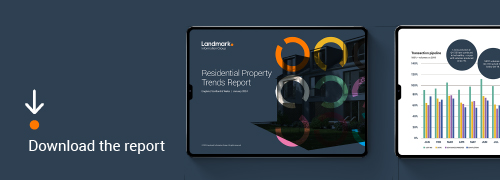
Download the Cross Market Activity edition covering England, Wales and Scotland, revealing the most recent residential property market data for Q4 2023. We hope you find the report a helpful steer as we begin 2024.
Landmark’s major new cross-market report has uncovered the top challenges and priorities for 2024 shared by estate agents, conveyancers, surveyors and lenders across the transaction chain.
Our new cross-market report found that market challenges and the length of time it takes to complete a transaction to be among the top frustrations shared by all residential property professionals.
The report, entitled ‘Future Thinking: what’s driving property professionals into 2024?’, features the views of hundreds of estate agents, conveyancers, surveyors and lenders.
A striking convergence
Our findings highlight some of the challenges and frustrations that senior property professionals are currently prioritising and sense-checks these against the aspirations of home movers.
Here are some of the key headlines:
- Economic headwinds have clearly affected the sector, with over 75% of all groups citing the current economic climate, interest rates and the cost of living as a leading business concern for the next year.
- The length of time to complete a transaction was a top three frustration in the transactional process for estate agents (37%), surveyors (40%) and lenders (36%).
- The ever-increasing regulatory and admin burden placed on property professionals appeared as a top five frustration for all four groups, with lenders ranking highest in this area, with 55% agreeing.
- All groups spent over 20% of their working days chasing or being chased – with poor communication among stakeholders cited as a top five frustration for estate agents and conveyancers in particular.
- Looking ahead, better technology and less administration were seen a key for all groups in improving efficiencies and reducing costs.
Protracted timeframes
Our research also canvassed the views of 500 home movers, with this group also sharing the sentiment expressed by property professionals to speed-up transactions. In fact, the majority of consumers aspired to wrap up their home moves within an 8-week timeframe – which is in stark contrast to the current average transaction time of 19 weeks1.
A desire for digitisation
The report also highlighted a remarkable consensus regarding the best solutions to addressing these challenges. Digitising workflows featured highly for three of the four groups, with surveyors (63%) and lenders (55%) ranking it as the leading factor that would have the biggest impact on productivity, and estate agents placing it third (41%.)
Simon Brown, CEO, Landmark Information Group says:
“Our research has thrown into sharp focus the many shared challenges our sector is facing. It also reminds us that we’re all part of the same property ecosystem, and although our roles and areas of expertise are different, we share more areas of commonality than we perhaps thought.
“If we are all experiencing some of the same frustrations around difficult communications, increasing amounts of administration and a desire for better technology, then we need to focus on a collaborative solution to provide the speed and certainty the property professionals and consumers are so desperately craving.”
Access our new market research report here.