Landmark’s Q2 2025 Residential Property Trends Report is now available. This report features the latest data on residential property transactions, including listings, SSTC/SSTM figures, search orders and completions.
Our data reveals muted market momentum following a stamp duty-fuelled surge in March. Completions cooled in Q2 compared to 2024 levels – veering from a 79% year-on-year uplift in March to a 32% dip in April.
Listings volumes were up 5% on 2024 levels, indicating a continued strong intent to move. However, affordability continues to constrain demand from progressing.
The market in Scotland remained consistently stable with stronger market momentum translating into listings volumes that were up 14% on Q2 2024. Meanwhile, volumes of Sold Subject to Missives (SSTM) and completions tracked in line with last year’s volumes.
Other key findings from Q2 2025 include:
- Listings volumes in England and Wales were up 5% in Q2 ‘25 compared to Q2 ‘24. In Scotland, listings were up 14% in Q2 ’25 vs Q2 ‘24.
- In England and Wales, SSTC volumes in Q2 ‘25 were down 7% vs Q2 ‘24. SSTM levels in Scotland were down 3% compared to Q2 ‘24.
- Completion volumes in England and Wales were down 20% in Q2 ’25 vs Q2 ’24. In Scotland, completions were up 1% compared to Q2 ‘24.
Download your copy of the Cross Market Activity edition for England, Wales and Scotland, which includes the latest residential property market data and insights for Q2 2025.
Landmark’s Q1 2025 Residential Property Trends Report is now available.
This report, from our parent company Landmark, features the latest data on residential property transactions, including listings, SSTC/SSTM figures, search orders and completions.
Our data for Q1 ‘25 reveals signs of a resilient market and a stable transaction pipeline emerging following the spike in completions ahead of the Stamp Duty Land Tax (SDLT) reversal deadline in England and Wales.
Completions rose by 30% over the quarter, with a 71% year-on-year surge in March alone as buyers rushed to complete. Beyond this much-anticipated bubble of activity, underlying indicators point to a more resilient property market heading into Q2.
The Scottish property market continued to hold firm, avoiding any notable market distortion following changes to Land & Buildings Transaction Tax (LBTT – the Scottish equivalent of SDLT).
Other key findings from Q1 ‘25 include:
- Listing volumes in England and Wales were comparable to Q1 ‘24, up by just 1%. In Scotland, listing volumes were up 11% for the quarter compared to Q1 ‘24.
- In England and Wales, SSTC volumes were down 9% compared to Q1 ‘24. Conversely, SSTM volumes in Scotland were up 9% vs Q1 ‘24.
- Completions were up 30% in England and Wales (+71% in March alone). In Scotland, completions were up 16% compared to Q1 ‘24.
Download your copy of the Cross Market Activity edition for England, Wales and Scotland, which includes the latest residential property market data and insights for Q1 2025.
Building on the success of their new residential search reports launched last November, our parent company Landmark are delighted to unveil their new and improved commercial search reports.
The reports are designed to help commercial real estate professionals reduce the time spent interpreting data and access the information they need more easily.
Environmental Insights Remastered
Landmark’s remastered commercial reports feature unmatched data and clearly defined assessments that empowers commercial property lawyers to navigate the detail seamlessly. With enhanced clarity, they’ll provide all the relevant information to power confident decision-making.
Simple, straightforward, but never standard – led by commercial property lawyers
Landmark engaged with a large number of commercial property lawyers to shape the design and product brief. The overwhelming response was a call for reports that are more precise, easy to understand and easily direct you to the detail when required. Based on this valuable feedback, Landmark have refined the new commercial reports to be simple, straightforward, but with the most comprehensive information.
Comprehensive due diligence, made easy
- New and upgraded risk modules: Landmark have enhanced their reports to ensure they provide the most comprehensive reports in the market but also the simplest way to convey environmental risk.
- Optimised for today’s workflow: Visually enhanced front pages provide greater transparency for commercial property lawyers, saving valuable time.
- Executive summaries: New executive summary pages for both conveyancers and clients to quickly and easily understand which risks are relevant for that location and what to do next.
To view the remastered catalogue, click the related products links below. For details on Landmark’s new residential portfolio offering, click here.
In 2024, we witnessed steady but consistently lower transaction volumes. That begs the question: Why don’t lower volumes mean faster transactions?
Spoiler alert: aside from some marginal variances, property transaction timescales did not vastly alter in 2024, despite reduced transaction volumes. The question is: why?
Our parent company Landmark Information Group’s latest Property Transactions Report – entitled Why don’t lower volumes mean faster transactions? – seeks to answer that question (and more), delving into 17 years’ worth of data, with cross-market commentary from our experts.
Major talking points covered in the report include:
- What are the persistent bottlenecks in the home-buying process?
- Where have timelines improved?
- How do property transaction timescales compare to consumer expectations?
In this report, we analyse the time taken between key transaction milestones and how they have changed over time, including:
- Instruction to completion timescales for sales and purchases
- Contract issued to buyer enquiries received timescales for sales
- Instruction to mortgage offer received timescales for purchases
Access your copy of the report by visiting this link.
The property transaction process is a complex jigsaw puzzle involving multiple pieces – conveyancers, estate agents, lenders, surveyors, and, of course, the buyers and sellers themselves. Typically, these groups have often operated in silos, with communication barriers and information gaps hindering efficiency and causing frustration for everyone involved.
However, there’s a growing recognition that breaking down these silos and fostering a collaborative approach is crucial for streamlining transactions, reducing stress, and improving the overall experience for all involved. When asked what would make the biggest positive impact to their productivity and business success, 43% of responders to Landmark’s recent market research suggested that less chasing between stakeholders was top of their list of requests, as well as greater transactional visibility (29%).
So, what are the first steps? Understanding the issue at hand is the first jigsaw piece.
Silos: the unwavering obstacle in property transactions
There are several headaches that could potentially occur when all parties involved in a property transaction work in isolation from each other:
- Communication breakdowns: Information gets lost in translation, leading to misunderstandings, delays, and errors. Sometimes key knowledge may only be known by one person, leaving transactions susceptible to annual leave, sickness, or departures.
- Duplication of effort: Different parties may end up requesting the same information or performing the same tasks, wasting time and resources.
- Lack of transparency: Buyers and sellers may end up left in the dark about the progress of their transaction, leading to stress and frustration.
- Increased risk: Without a clear overview of the entire process, potential risks and issues may be missed or addressed too late.
Elizabeth Jarvis, Managing Director of OneSearch echoed this point in a recent industry roundtable discussion: “One of the biggest frustrations [in the industry] that is wasting time really is chasing one another through all different parts of the process.”
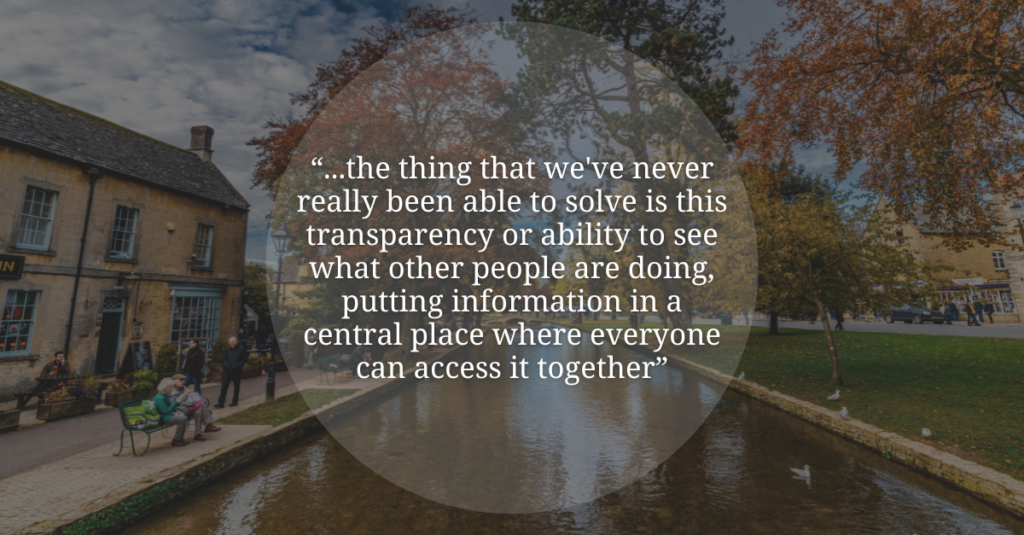
“I wonder why it has taken a really long time,” Elizabeth continued, “It feels like the thing that we’ve never really been able to solve is this transparency or ability to see what other people are doing, putting information in a central place where everyone can access it together instead of it being phone calls and emails.”
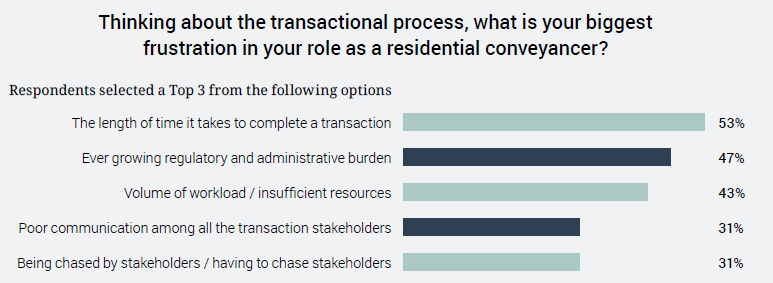
The recent survey highlighted these issues, with 53% of responders listing the length of time it takes to complete a transaction as the biggest frustration, with poor communication (31%) not far behind.
The Benefits of Collaboration
In contrast, a collaborative approach to property transactions offers numerous advantages:
- Streamlined communication: A centralised platform or system allows for seamless information sharing between all parties, reducing delays and preventing miscommunications.
- Increased efficiency: By working together, parties can avoid duplication of effort, optimise workflows, and accelerate the transaction process.
- Improved transparency: Clients have a clear view of the progress of their transaction, reducing stress and building trust, without too much of a bombardment of communications.
- Reduced risk: A collaborative approach allows for early identification and mitigation of potential risks, ensuring a smoother and more secure transaction.
- Enhanced client satisfaction: A more efficient, transparent, and collaborative process leads to a better overall experience for buyers and sellers.
Technology at the heart of progress
Technology plays a crucial role in facilitating collaboration in property transactions. Digital platforms and tools can:
- Create a central hub: Provide a single source of truth for all transaction-related information, accessible to all parties.
- Automate tasks: Reduce manual effort and streamline workflows, freeing up time for more valuable activities. This includes checking of potentially incomplete documents, so that time isn’t wasted when this is discovered weeks after uploading.
- Facilitate communication: Enable real-time communication and collaboration between parties, regardless of location.
- Enhance transparency: Provide clients with online access to their transaction documents and progress updates.
Rob Steadman, Sales Director within Landmark Information Group, who also participated in the roundtable, noted that future offerings from Landmark were placed to be an ideal solution.
“There’s potentially new things that [Landmark] are bringing to the market, which is harnessing the power of AI. The fact that we touch across the whole property ecosystem so that gives us a really good insight into transactions”
“We’re excited really with the position that we’re in…almost to have a vault that’s very clear, very secure.”
The Role of Conveyancers in Driving Collaboration
Conveyancers are uniquely positioned to champion collaboration in property transactions. They act as a central point of contact for various stakeholders and have a vested interest in ensuring a smooth and efficient process, such as:
- Advocate for technology adoption: Encourage the use of digital platforms and tools that facilitate collaboration.
- Promote open communication: Establish clear communication channels and protocols with other parties.
- Educate clients: Explain the benefits of a collaborative approach and encourage client participation.
- Build strong relationships: Foster trust and mutual understanding with estate agents, lenders, and other stakeholders.
Breaking down silos and fostering collaboration is not just beneficial – it’s essential. By embracing technology, improving communication, and working together, all stakeholders can contribute to a more efficient, transparent, and client-centric process.
The individuals within the conveyancing sector have a key role to play in driving this change. By championing collaboration, conveyancers can enhance their own expertise, improve client satisfaction, and contribute to a more streamlined and efficient property market.

The conveyancing sector is facing a perfect storm of challenges as 2025 gets up to full speed. Regulatory burdens and economic uncertainty, to the rise of AI and automation, all whilst battling clients demands and expectations; it’s a complex industry landscape, perhaps more so than ever before.
However, amongst these challenges, a spirit of resilience and proactivity is emerging. Conveyancers are taking control of the controllables; embracing innovation and seeking solutions to streamline processes and improve efficiency.
This shift in mindset is evident in the recent market research from Landmark Information Group. Over half of responders (52%) are now taking matters into their own hands by assigning workloads more effectively, while 34% are digitising more processes. Proactively sourcing new business and investing in improved training are also high on responders 2025 priorities.
What Tech Can Do For You
Understanding and integrating new technology can be a daunting task for conveyancing firms, especially with the rapid pace of recent advancements.
“Everybody’s grappling with the fact that the technological capabilities [in conveyancing] are accelerating at such a pace,” admitted Rob Steadman, Sales Director within Landmark Information Group.
“If you deploy AI today, tomorrow there’s almost like the next better version of AI to change it.”
Liz Jarvis, Managing Director of OneSearch highlights the need for dedicated education and training: “There’s an assumption by a lot of people that there’s all this information out there about tech, prop tech, and AI technology, and how it can help your firm. But actually, I don’t think that that’s fully translated into how it can be adopted.
“I think conveyancers and others doing this role, they actually need a lot more information about what that can do [for them] specifically, rather than big noise of a release of this technology. What does it mean to me and to my firm? How long will it take me? How long and what cost will it take for this to embed in my business?
“There’s the worry, what if I invest this money now? Is it obsolete in 12 months’ time?”
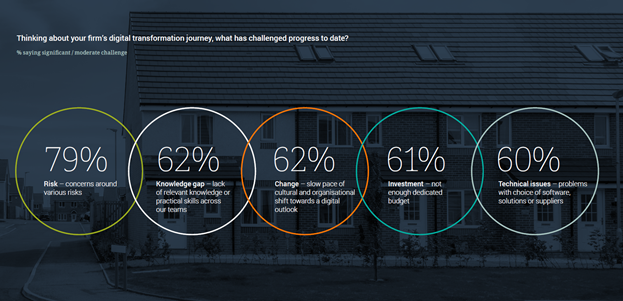
The feels are reflected in the market research; 62% of respondents listed the knowledge gap within their team as an aspect which has challenged progress, as well as the slow pace of change towards a digital outlook (62%).
Collaboration and Communication: Bridging the Gaps
Another key theme for 2025 is the need for improved communication and collaboration among all stakeholders in the property transaction process. Participants highlighted the frustration caused by chasing information and the lack of transparency in the system.
Liz Jarvis continued along this point: “One of the biggest frustrations and things that is wasting time really is that chasing one another through all different parts of the process whether it would be a surveyor, an estate agent, the other side of the transaction, the purchaser or the vendor.
“I wonder why it’s taken a really long time. It feels like the thing we’ve never really been able to solve is this transparency or ability to see what other people are doing, putting information in a central place where everyone can access it together instead of it being phone calls and email.”
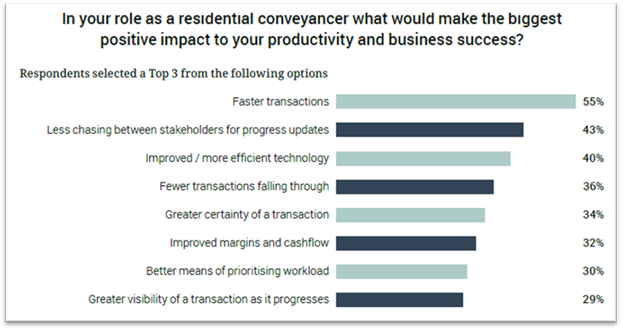
This desire for greater transparency and collaboration points to the need for solutions that can bring all stakeholders together in a central hub, providing a single source of truth and facilitating seamless information sharing.
Looking Ahead: A Call for Bold Leadership and Continued Innovation
The recent market research from Landmark paints a picture of a sector that is facing challenges head-on, embracing innovation, and actively seeking solutions to improve efficiency and client experience. Conveyancers are taking control, demanding more from technology providers, and prioritising collaboration and communication.
Moving forward, direction and continued innovation will be crucial. As Rob Steadman emphasised, “It’s going to come down to bold leadership across the sector to be clearly heard as to what their priorities are.”

By working together, conveyancers, technology providers, and other stakeholders can create a more efficient, transparent, and client-centric property transaction process. The challenges are real, but the opportunities are even greater.
The Landmark 2024 residential conveyancing survey tells a ‘tale of two halves’. One is about hope for economic stability as we enter autumn with listings and sales volumes rising, and interest rates falling. The other is about how conveyancers are still struggling with slow transaction times, insufficient resources, and general lack of transparency. For more details, be sure to download the market research results today.